
Planning board enthusiastically approves site plan for Tupper Arts conversion of State Theater
by Dan McClelland
Tupper Arts proposed ambitious renovation of the historic Adirondack State Theater was the subject of a site plan review and State Environmental Quality Review Act (SEQRA) at last month’s planning board meeting.
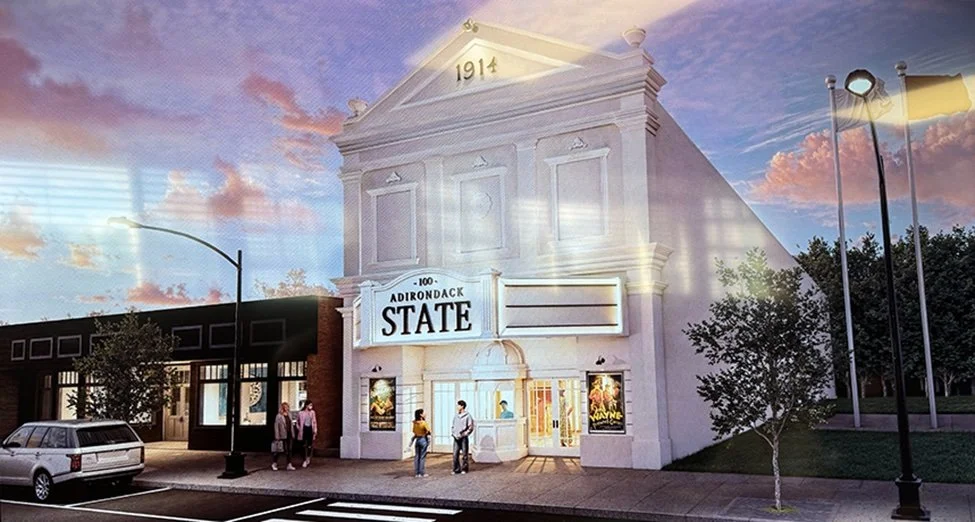
What the planners saw were some impressive architectural sketches of the new theater lobby and the new exterior view, completed by Architect Andrew Chary, a member of the Tupper Arts board.
The sketches brought comments of “wows” and “very nice” as they came up on the video screen.
Along with the full-color images were various engineering drawings of the many renovations planned that will not only revitalize the century-old Park Street landmark at 100 Park Street but add a stage for live performances. In all, the packet submitted by Tupper Arts leaders contained over 40 pages of documents for the work planned next door to the arts center.
Planner Jessica Eggsware told the volunteer planners that there already has been some drainage work done in the alley way behind the building to prepare for the major renovation work ahead. The new drainage lines run into a storm water drain there.
The roof on the theater building is new and so doesn’t need to be included in the scope of work planned, she noted.
She said there will, however, be a new roof support system installed to accommodate various lighting and sound equipment installed in the interior.
In attendance was Tupper Arts Chairman Susan Delehanty and Planning Board Chairman Shawn Stuart asked her if she wanted to comment, telling her “obviously it’s fantastic what you have proposed.”
She told him and his colleagues: “the only things I just wanted to note is that there are many things that we want to add to our plan for the theater at some point later. One of those is a fire suppression/ sprinkler system.”
The arts leader said they have applied for a grant to help fund that system and they are currently waiting to hear on it.
“We’ve asked our engineer doing the design to keep that in mind and to make sure the duct work and the permits are in place to accommodate that when it can be done. The same thing goes for the electrical system. We want to eventually add theater lighting and sound features and so that may be accomplished by some equipment we buy later. So we wanted to make sure the new electric panels and all the wiring for that future equipment is in place now.”
She said the plan and conversion of the building “has been set up so we can really use it to its fullest potential, even though when we first open we may not have all that equipment in place.
“We’re writing grants constantly to win the funds to help us add those things to really enhance the use of the building and also make the viewing and listening qualities excellent!”
Mrs. Delehanty told the planners her group “hopes to go out to bid” within the next 30 days. We’re working on the bid document paperwork right now.”
She said among the bids offerings ahead is an initial one for asbestos testing.
She said they expect a number of responses to their various construction bids when they are advertised. “We’ve already had three contractors contact us” to make sure they were notified of the forthcoming bid offerings.
“We’re hopeful over the summer we’ll award those bids and get started. We do have some funding in place already that we can draw down from. We’ve already raised some other money, that has been specifically set aside for this project. -And as I said before, we are writing grant applications continuously to hopefully produce the grants to raise the money it is going to take to complete the full construction.”
Besides the praise offered by the planners for the project, a lone question came from Board Member Jan Yaworski. She wondered about the lighting planned for the front facade of the historic theater.
Mrs. Delehanty said those plans have recently changed. Originally in the first plans some of the lights were shining upwards, but Mr. Chary changed that to make sure that all were shining downward, in keeping with the community’s dark sky-compliance.
“We wanted to be very considerate of the night sky,” she told her.
She also noted that the new marquee will extend a bit farther out above the sidewalk than the current one. “That will actually provide a little more protection for people for people waiting to go into the theater.” The extension, she said, won’t interfere with the village’s sidewalk plow operator going along there each winter.
“We did receive a variance from the village zoning board of appeals for that,” she told the planners.
There was a question that evening about if the converted theater once finished will allow for live theatrical projections that an amateur theater group might use and she replied “absolutely.”
“One of the interior design changes we’re making is expanding the stage and getting rid of the fixed screen that’s there and replace it with a retractable one that when lifted will produce a full stage to accommodate live performances and lectures, as well as movies,” she explained.
Mrs. Eggsware read a long and detailed resolution that essentially stated the joint village planning board has thoroughly reviewed the project under the SEQRA and that it represents no negative environmental impact on the community as a Type II action and that the building is not currently listed on the state’s register of historic buildings.
The resolution was approved unanimously by the board that evening.