
Wild Center marks 20th anniversary with day full of fun and shared memories
by Dan McClelland
It was a perfect Adirondack day for the celebration of a major milestone in Tupper Lake. Over 3,000 friends and supporters of The Wild Center from Tupper Lake and from all across the country came to celebrate its 20th anniversary.
The day boasted one of the largest daily turn-outs in years, even surpassing those following the introduction of the Wild Walk several years ago.
For many of the guests that day it was their first look at Thomas Dambo’s six large trolls, in what has been billed as a whimsical outdoor adventure that is entitled “Trolls: Save the Humans.”
Hundreds Saturday roamed The Wild Center trails to see these curious beasts, all made from an assortment of scrap or recycled wood by their Danish creator.
For the free party The Wild Center staff went all out with nature-related activities from start to finish that day.
Events featured a 20-year history exhibit at the Naturalist Cabinet, a Creature Features in the Great Hall, live music by David Wells on the main stage, a special Otter program, a special showing of the film “Wild Adirondacks” in the Flammer Theater, pond stocking in Greenleaf Pond, all capped off in style by a musical performance by Martin Sexton, known for his soulful voice and songs laced with powerful story-telling.
There were Wild Center booths scattered around the far parking lot, where staff members showed adults and children how to make and create various souvenirs of the special day. A half dozen food booths offering a variety of special domestic and international culinary treats and with them were the local Lions with their familiar fare, always smothered with Lions onions.
Many also enjoyed sampling The Wild Center’s homegrown maple syrup, served at the facility’s sugar shack.
Community Bank staff had a booth to recognize the institution’s 160th anniversary this year, with plenty of friendly smiles by staff members in bright orange tees and giving souvenirs aplenty.
For the comfort of the guests roaming the grounds and the celebration venue was a restroom trailer, fully equipped and the envy of event organizers everywhere.
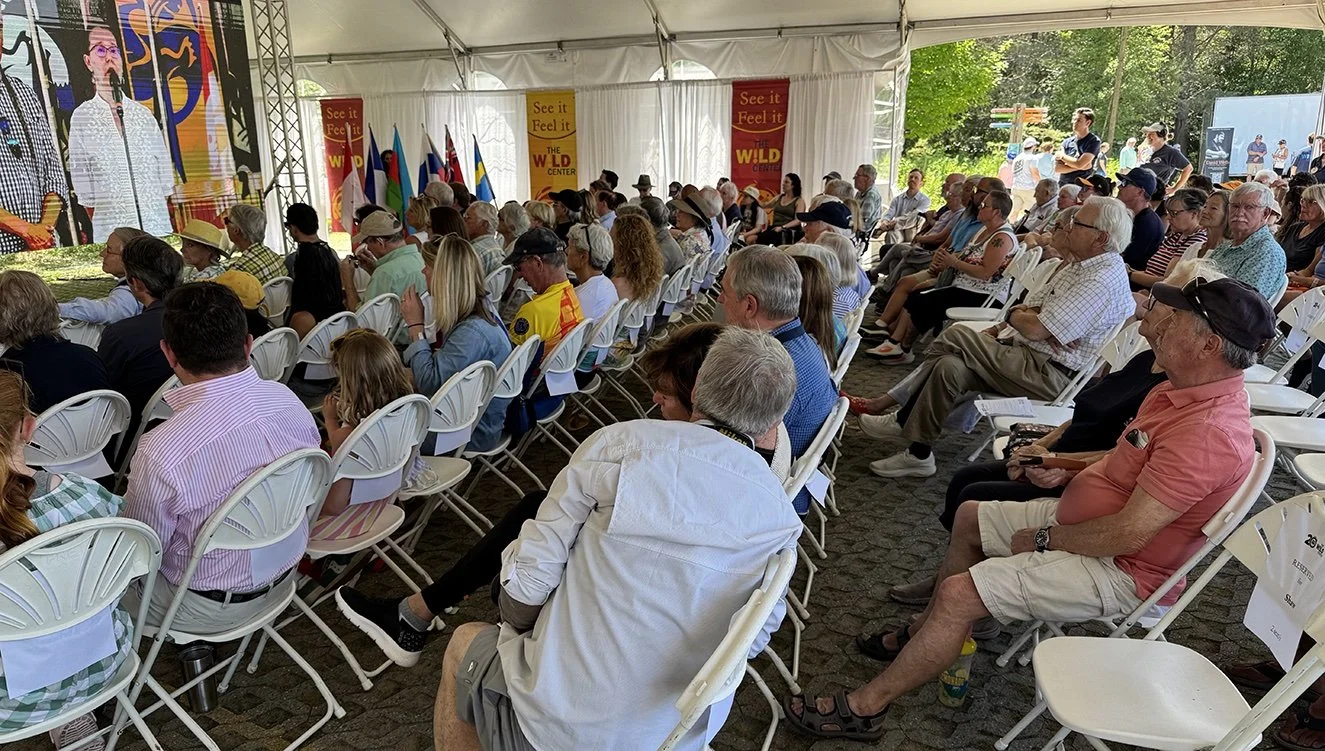
The main event commenced at about 2p.m. on a stage in front of about 400 guests with reserve seats under a huge tent. With the mercury hovering about 75 degrees F. and a gentle breeze blowing, the seating in the shade of the tent was comfortable for all.
The official ceremony marked the two decades the popular natural history museum has been drawing Adirondack-lovers and teaching people of all ages lessons about nature and its value in society today.
The guests were welcomed by Meadow Hackett Rutenbar, a member of the board of trustees of The Wild Center. She is a senior manager on the Sustainability & Environmental, Social, and Governance (ESG) services team within the Audit & Assurance business at Deloitte and Touche, PLLC.
“Thank you so much for coming here to join us for the Wild Center's 20th anniversary. Twenty years ago, when we opened our doors I was here. I was a sixth grader in a tent just like this, and I listened to people share their hopes for what this place could become. I'm not sure anybody could have predicted all of this!
“Today, it's my honor to introduce another group of speakers, many of whom have deep personal connections to The Wild Center and the Adirondacks. First are David Kanietakeron Fadden , and Margaret Kaniatiiosta LaFrance.
“David grew up near here in Onchiota, the location of the Six Nations Iroquois Cultural Center. He is an Akwesasne Mohawk artist, storyteller, and beloved member of our community. He also sits on The Wild Center’s board of trustees.
“Margaret grew up in Akwesasne. She is a traditional Mohawk language teacher and reading interventionist at Salmon River Elementary. Today, Margaret and David will deliver the Haudenosaunee Thanksgiving address, a traditional introduction offered before important gatherings. Please join me in welcoming Margaret and Dave.”
Loud applause erupted for the pair.
The Akwesasne Mohawk Thanksgiving address an ancient Haudenosaunee tradition that by its meaning it is meant to come before everything else each day.
Margaret addressed the crowd in both English and her native language.
She said she was a member of the Wolf Clan. “So today and this year as the United States celebrates its 250th year we, from the Iroquois Cultural Center, feel honored to be invited here and included in this event with The Wild Center to share with you our language and a little bit of our culture that's been here for centuries before the United States existed and we just feel so proud that we're still here to share that with you today.
More cheering from the audience, followed by more native language from her.
“So what I just asked is that we all put our minds together as one, to show honor and respect to the natural world and all its components that allowed everyone to gather here safely and healthy today. So that's what we're going to be doing in the next few minutes.
She then recited the thanksgiving message in her native language for the next four minutes.
She was followed by David Fadden, who said he was born “just down the road” in Onchiota. He said his purpose that afternoon was to explain what Margaret had told them all. He said those words in her native Mohawk language “have echoed all across these mountains for thousands of years. And these words that are spoken in our language are the words that we say before we begin, or before all else. And we're supposed to do it first thing in the morning,” joking “so today we're a little late.”
He said the morning message is supposed to be done by every individual but you can do it in your head. “You can say it out loud, but we especially do it when we gather. We have this wonderful gathering today, and it's quite amazing. Could we have picked a more beautiful day. I don't know who planned it, but it's right on.”
“We say these words just to put our minds in one place. Because around us, our day to day lives, we watch the news, and all the troubles of the world. We must remain thankful!
“In the United States on one day of the year we celebrate Thanksgiving. Among my people we do it every single day.” He joked: “We don't eat turkey every day, but we say these words every day.”
Well, whenever we gather, we say these words first, and we greet each other as humans. Today some of us have traveled from some distance. I even heard someone came from Florida just to see the trolls today. That's pretty amazing. But we're here. We're all smiling. I've seen a lot of smiling faces to me. You all seem happy, in good moods.
“Do we appreciate the existence that we have? It's a gift. And so we greet each other as humans. And say thank you with one voice. And from there, we move to our mother, the Earth. And without our moms, we wouldn't be here. And this earth is our mother. She provides everything. Everything maybe, even life. So we gather our minds together as one voice, and we offer greetings for Thanksgiving to our mother, the earth.
“And from there we move to the waters...the rivers, the streams, the ponds, even the little brook. Without water, we wouldn't last very long. Water is life. We might last a few days without it. So we gather our thoughts and our minds together as one and we sent greetings and give thanks to the waters of the world.
“And we turn to the fish that live in those waters. I just saw a nice one in that building over there. Pretty blue. We see the fish that swim around, and then cleanse the water, and we fish to help feed our bodies. We remind ourselves to speak with one voice and offer thanks to the fish.
“And from the fish we move up to the plants. All the beautiful plants you see walking about. They bring happiness just by looking at them. All sorts, all different colors, all kinds. So we gather our minds together as one, and we offer thanks to all the plant life. -And to the medicine plants. There are certain plants that were put here on the earth to provide medicine to stave off illness. We offer thanks as one voice to the plants that give us medicine.
“And we turn to the roots of those plants that go deep into the ground. Those roots draw up the nutrition from the soil, the earth, to those plants. They hold the earth together, so it doesn't wash away. So with one mind, we gather our thoughts together as one. We offer thanks to all the roots of the world.
“And from there, we move up, and we look to the animals. You have the deer. I saw one last night. Scared me!” Laughter from the crowd.
“I turned on the outside light of my home and there she was right there. The deer, the bear, the wolf, the coyote, the fox, the bob cat, all of the animals we see. My cousin saw a moose yesterday in Lake Clear. So there's one hanging around. But those animals provide food, clothing. And in the old days, even their bones were used for tools. So we gather our minds together with one voice, we offer thanks to the animals of the world.
“And from the animals, we look to the trees all around us. They clean the air. The trees, they provide shelter. They provide heat in those cold winter days. Without trees we would be in trouble.”
As addressed the things they give thanks for a slide show in the background provided appropriate graphics and photos.
“From the trees, we looked at the birds, the ones that live in the trees. My grandfather always said: ‘Whenever you hear their songs, that song that's in our hearts, it grows, it grows really bright. It brings happiness to us when you hear their songs.
“Last evening, I heard the Hermit Thrush. It's probably the most beautiful song I ever heard in my life. It was way off in the woods. It's like a flute. And it just elevates you, just listening to those sounds. But without their songs, life would be pretty simple. And we looked to the eagle as the leader of the birds. So, we got our minds together as one, and we offered thanks to the birds.
“And from there, we move up, and we look in the storm skies to the thunder. The first time in the spring when you first hear the thunder, we respond with tobacco as an offering of Thanksgiving. Because if you stop hearing thunder, something's wrong. That means a rain isn't coming. If we call it ‘our grandfathers’. When you hear the grandfathers come, you know the rain's coming. The rain replenishes the water in all the streams, rivers and ponds. And without that (native word) they would dry up and life would be very hard. So we gather our minds together as one, and we offer thanks to the native word for thunder.
“From there, we move to the four directions...the four winds. The winds from the north brings that deep cold that chills you right to your bones. The wind from the brings the warmth, that brings the spring. The wind from the east is damp and chilly. The winds from the west bring the storms. But what that air does, those winds, is it replenishes the air we breath. It cycles all around. So we gather together as one, and we offer thanks to the wind,” Mr. Fadden explained.
“And from there, we look up higher. Today, you look outside, don't look directly at it, but it's our elder brother, the Sun. And that brings that beautiful warmth. The sun is the elder brother of a male sports. They say the sun likes sports, like, lacrosse. So we got our minds together as one, and we offered names to the sun.
“Then we look to the night sky, the moon, our grandmother. The grandmother looks after all female life, and babies are born, according to her. So, we offer our thanksgiving to our grandmother, the moon.
“Thanks to the stars that guide us at night, we have stories that go along with those stars, and teach us valuable lessons of life. So we always look to the stars to remind us of our history, through stories. They say during the nighttime, those stars leave the dew on the grass around us. So we gather our minds together as one, and we offer thanksgiving to the stars. And all of those things together is what we call our lives.
The ceremony leader, Mrs. Rutenbar told the well wishers that day that “Dave's perspective was so important to shaping our ways of knowing exhibit, which shares indigenous knowledge of nature alongside the view I learned in school. It welcomed me into this space while showing me a side of the Adirondacks I had rarely encountered in a way that made me ask: ‘What else don't I know, and what more can I learn?’”
“I think that is one of the things the Wild Center does. We don't often like to reflect at the Wild Center, as we are focused on what more we can find. For 20 years, it has been our constant desire to innovate, to lead, to discover anew, to recreate through recreation, to think about things differently, to present them in new ways and where everyone can participate along. We are a place that takes the great Adirondack experiment of people and nature thriving together, and encourages visitors to explore more at their own pace. It doesn't matter if you are completely at home in the woods, or the thought of hiking and camping makes you break out into hives. We meet you where you are.
“My father, Joe Hackett, was an Adirondack guide and outdoor writer. I was lucky enough to grow up in a world with a few simple truths. Outside was better than in. The natural world isn't to be feared, but to be revered and an endless source of learning. And simply going for a walk in the woods can solve most of life's problems. At the right age of 12, I was introduced to the Wild Center on opening day, and we began a fast friendship. On that day, one of the speakers read a poem I wrote about growing up in the Adirondacks. I talked about my ride to school, and how the sight of The High Peaks and changing leaves deeply affected my world view. Which, admittedly, was limited. I was only a middle schooler, after all.
“Throughout the years, the Wild Center and I have discovered the world together, and I've learned more about not just the Adirondacks, but the world far beyond the blue line that I can’t quite articulate in just a few minutes. I helped plan the inaugural youth climate summit, and participated with Saranac Lake High School in our first year. Like any good friend, the Wild Center and I have traveled the world together. I represented the youth climate program in Finland, in Paris, France, at COP 21 in Bangkok, Thailand. And in our nation's capital in front of representatives from NASA, NOA, the Department of Energy and the White House.
“Just a quick note, the 14 international flags that were carried by our youth climate alums represent the countries in which The Wild Center has either held a youth climate summit, teacher training or attended a major international meeting in the past 20 years. How about that? “
Loud applause from the crowd.
“I could go on. I was a summer naturalist here during college. I got my guide license to lead canoe trips on the Oxbow, and for the past five years, I've been a member of the board of trustees. I watched The Wild Center grow up!”
She becomes emotional for a moment and upon regaining her composure joked with the crowd that is why your MC shouldn’t be a pregnant lady.
“I learned about the ways we each affect our environment, I also learned we don't have to be passive observers as our world changes. We can take action to create a more equitable and sustainable future. That understanding is the result of my many Wild Center experiences, and, ultimately, shaped my studies in energy policy and climate, in my career, helping corporations manage environmental, and social impacts of their activities, as a leader within the sustainability practice, definitely.
“The Wild Center helped me discover my voice. It shaped my life trajectory!” More applause.
“Twenty years ago I wrote: ‘The Adirondacks are what makes the world what it's supposed to be.’ That was a good line. It holds up today!
“ As I walk around today and see so many visitors to The Wild Center, I'm so excited that every single person here will see something that inspires their own joy and reverence for this place. When I was in Finland, we met with the U.S. ambassador, who told us it was our duty and responsibility to take what we learned, to touch, move and inspire the youth. And I know there's a child visiting here today who says, ‘I never knew that about the Adirondacks. I never looked at my world in that way. I want to be part of the solution to some of the challenges that we face. I want to use my voice to make it happen. And the Wild Center will be the spark!’”