
Support for O.W.D. apartment complex PILOT strong at public hearing Tuesday
by Dan McClelland
Of the speakers who rose from the audience to offer their comments into the record of last Tuesday’s public hearing by the Franklin County Industrial Development Agency on the proposed O.W.D Tupper Lake LLC apartment complex all but one person supported it.
First to speak was former mayor and county legislator, Paul Maroun, who said he was “involved bringing this group here.”
He said he has seen the fine work of Joe Gehm and his investors and partners in Utica and Syracuse in the development of their apartment and condominium projects over the years.
On a table were sketches of a half dozen or so former industries that the developers have converted into housing and commercial complexes.
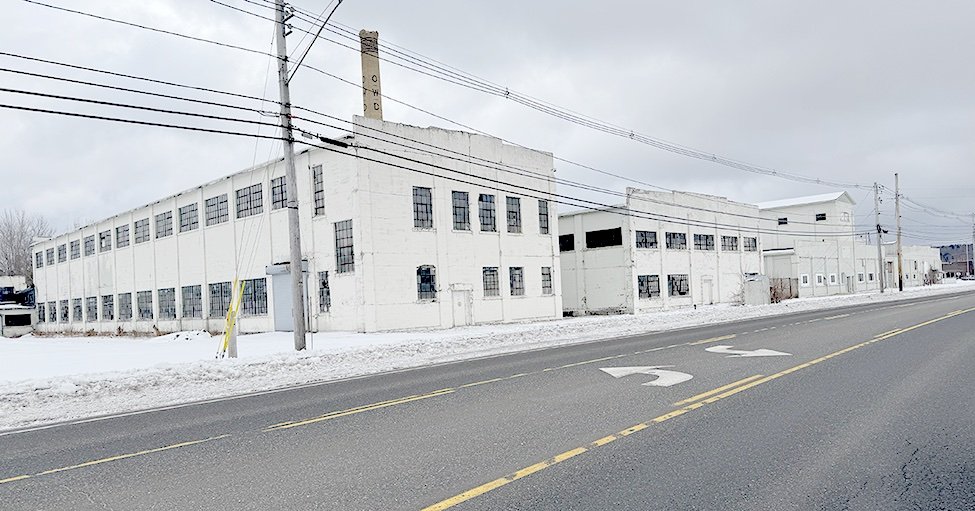
He said the reason he pushed for this project so hard over the years when he was in elected office was all the times he heard from constituents: ‘What are you going to do about that blight on The Boulevard?’”
He said for the village or town to tear it down, the way its built with reinforced steel and concrete, it would cost millions of dollars. He admitted he didn’t know any contractor here who would be willing to buy the property and tear down the old factory buildings for another purpose.
He called the deteriorated former factory complex a disincentive for any other developer to erect modern condominiums and townhouses across the street from it, as was proposed by Lou Restifo, years ago. “Would you want to build a modern hotel nearby, as has been proposed, with that dilapidated structure sitting there?”
“Now we have folks willing to clean up the site and make a modern residential/commercial complex. They should be applauded!” He felt it will be a strong incentive for other developers and investors to do likewise here.
He said he understands why people hate PILOTs but they are a common incentive across this state and Vermont to get developers to come into communities and tackle these important projects.
Mr. Maroun said he understands the O.W.D. Tupper Lake LLC developers will not be paying as much in taxes for the 20 years of the PILOT, “but in the long run our community will benefit and hopefully grow as their project may induce others” to come here and invest in important development endeavors.
“Together these will increase our tax base dramatically in coming years!”
“-And we have to eliminate this blight! Can we do it as individuals? I don't think so! Can the village do it? I don’t think so. Can the town do it? No. I don't think either of them can do what needs to be done to put this program together.
“The people who are in charge of this operation are good people. I know there's some in the audience tonight.”
Lead Developer Joe Gehm was sitting in the second row.
“I've met with them... lot of times. And I went to Albany and I went to Washington to try and get them additional money.
“Why? Because there's no one else in this room that's going to fix that building. And we've got to get rid of that blight!”
He said he knows some complain about the large amount of state money involved in the $46 million expenditure. He said the project is different from a hotel or motel where the owner can increase room rentals. Those apartment rents are set and controlled by the state. The apartment complex will be required to charge rents he called “income-driven.”
“Jeremy tried to explain it this evening but income driven units means the owners are under state mandate” to just charge certain rents based on the tenant’s income.
“I strongly support this project. I've done all I could to get it to where it is today!”
He expects the new 80-unit apartment complex will free up houses owned by senior citizens who may move into the complex and sell their homes to younger families.
Those home sales at current sales prices will help increase the size of the community’s tax base, as their assessment will increase, he noted.
For some people who cannot afford to buy a home, they will be very comfortable apartments in which to live, he added. “I’ve seen their apartments and they are very nice and their operations are well run!”
“So I think it's a win-win for this community and for the county. Thank you!” Mr. Maroun concluded.
Next up was Adam Boudreau, a new town councilman and co-owner of Kentile Excavating.
In the interest of full transparency his first comment was that his excavating company is not bidding on any of the work put out by the new developers. “So I’m not benefitting personally from any of this!”
“To echo Paul, I thought about this from a business perspective. If you're looking at a $46 million build-out, and it's strictly coming from private investment, and you're relying on market rate housing to pay for it, your rents you charge are going to have to be $1,600, $1,800 a month. We know no one in this community could afford that. Instead, we have this mix where the developers have leveraged a lot of state investment, which forces us to look at affordable housing. I don’t think that it is a bad thing! In fact, I think that's a great thing. I think it mirrors what this community needs.
“It solves a real workforce crisis...80 new units of clean, safe, affordable housing for the workers we want and need.”
He said this approach is similar to the Park Street apartment project underway by the Northern Forest Center. “We’re building a genuine foundation for the people who make Tupper Lake run!”
Mr. Boudreau said the developers and their associated company, Housing Visions, has a proven track record converting old factories into modern apartment complexes. “I believe the number is 56 buildings so far. Some of them you see up here tonight, he said of the graphics behind him.
“It addresses a long standing blight, as Paul said. The Oval Wood Dish site has sat dormant for far too long. The project connects the improvements we've already made, moving our uptown and downtown neighborhoods into something coherent, a village that tells a story of momentum, not neglect. It will also trigger a chain reaction of commercial investment.”
Mr. Boudreau said people need to look at this project from the perspective of other investors looking at the Boulevard part of town. You think about a prospective hotel developer looking at a recently renovated town hall, or the Oval Wood Dish- Tupper Lake reimagined, or the new Timberjaxx Pass, the future bike shop and Jason Dattola’s impressive new garage under construction.
“Suddenly that stretch of road isn't a forgotten industrial relic. It's a corridor with real momentum. That's not potential. That's happening!
“Is this project perfect? Maybe not. Does a PILOT program excite the community? Absolutely not. But this is our one real opportunity. The PILOT discussion deserves honest scrutiny, and I understand the frustration of taxpayers who might ask why they must carry more of the weight. But this is exactly the type of project that earns that kind of support. It's community-serving, professionally managed, and catalytic in ways that benefit every property owner and business in the village and town!
“So finally, a question for the community. For decades, we've passed the shuttered industrial giant every single day. What do you want to see over the next 20? Because we have a choice!”
Adam closed by holding up two architectural sketches- one showing the building as it is now, and one with all new windows and doors, freshly coated and painted exteriors, modern lighting and landscaping. “Which do you prefer?” he asked the audience.
Jed Dukette, who created Timberjaxx Pass miniature golf and ice cream business nearly two years ago, came up to the microphone to ask a couple of questions. He thanked Adam Boudreau for “the plug” of his new business.
He said when he and his wife, Juli, were writing their business plan a few years ago some of the things they included was the coming of this new apartment complex, along with the rail/trail and all the other positive developments going on around us and across the community.
“So we're very excited about this… from a macro perspective, this sounds wonderful!”
He said he was disappointed there wouldn’t be the opportunity to ask questions, because he had several.
“You can ask them, but I can’t answer them” in this type of forum, Jeremy Evans, the IDA’s executive directors and public hearing host told Jed.
Mr. Evans offered to try to answer his questions after the hearing ended.
He explained he was wearing several hats that evening, but in his main role as public hearing administrator, it wasn’t his role to answer questions from the public.
Free Press Publisher Dan McClelland, who has written about and spoken at public meetings about the unfairness of PILOTs, had prepared to speak against the Oval Wood Dish one that evening.
“I hate PILOTs probably more than anyone in this room,” he stated.
He said, however, he had examined the PILOT analysis he downloaded from the IDA office in Malone several hours earlier and found many benefits for the community- specifically the increased tax revenue that will be generated there in coming years if a modern building is erected there by these developers.
From those PILOT and non-PILOT proposals he said that compared with the $642,469 that will be paid by the property owners in taxes in the next 20 years if the site remains idle, with the PILOT plan as presented the revenue generated for the community would be $1.82 million with the PILOT in place and $2.4 million without one.
“A million dollars and more could do a lot to help our community in coming years. We have a village with a completely stagnant tax base with little prospect for growth, a school district in dire financial straights and a town that desperately needs to fix its old and tired buildings.”
He also felt that the vacant property now assessed at $677,400 is likely to decrease further if the project doesn’t go forward and the developers move elsewhere. “Who else would want that property with the liability it holds for any owner because of the deteriorated structures there?”
“I think it’s assessed value will drop like a rocket if these guys walk away!”
“This will be a good project which should help our town over time.
He told the IDA representatives and the 50 or so in the gallery that evening, as far as this specific PILOT plan is concerned, he has come full circle and supports it for the benefits it will have here- many of which are badly needed.
For this PILOT anyway, “I’m seeing it as our community’s way of investing in a project needed here.”
Mr. McClelland also commended Mr. Gehm and his partners for assembling what he called “an impressive” funding package from the state, and one he figured that couldn’t be put together easily or without years of work by a future developer, should this current proposal be pulled.
He noted the various funding agencies contributing to that $45 million funding package he listed in the Free Press last week.
“-And I think if we pass on this and these developers go away, we could be looking at that site the way it is for years to come. Maybe forever!”
Tupper Lake Businessman Fred Schuller, who has purchased, renovated and re-sold many properties here, said he moved to this community 35 years ago when he and his wife purchased the Red Top Inn.
“-And it was a great town!”
“Right now half the people who were here then are not here now. On Park Street you have buildings that need to be torn down. He said too there are half the number of motels now than there when he moved here.
“I’m all for this project. There are PILOTs in this town that aren’t paying half of what these guys are preparing to pay. “You can look them up” on the tax rolls.
He said there are apartment complexes here also with 80 units and they pay less than $30,000 a year in PILOT payments. “Some don’t pay anything!”
He said most North Country communities have developments with PILOT plans- and all are a little different.
Mr. Schuller, who is busy in the garbage business right now, said the old factory building the developers want to rebuild into a modern apartment building has stood in disrepair for too long. “We need people in town and they will need housing!”
He said there is such a shortage of apartments here that he gets calls almost every day from someone looking for housing...looking for apartments.
“So I think we should support this project and its PILOT plan. -And 20 years when it expires, we’ll look at it again!
Mr. Schuller asked Mr. Evans how much his agency receives per PILOT plan it administers.
“Is it a one time or do you get money every year of the plan?”
Mr. Evans told him “we typically charge 1% of the project’s cost at the time of closing. He added that his agency also charge the holders of PILOT plans $1,000 per year to review them, as is required by state law.
“I live Tupper Lake. I have kids here, I have grandkids, they all have their own houses. I have built some houses here too. But Tupper Lake needs people because without people nothing will ever happen here.”
He said he liked the term workforce housing- the exact kind Tupper Lake needs if it is to ever grow.
Next to speak was relative newcomer Brian Merriam, a fourth generation of an insurance family in Schenectady, who recently re-built a long time family seasonal residence on Lake Simond Road.
“I lived there in Schenectady for 40 years before moving here a year and a half ago.
He said he ran the company that his great grandfather founded where there were 13 employees.
“We couldn’t find a good building in downtown Schenectady” big enough to accommodate our growing firm. “Everything was in B or C grade condition downtown Schenectady. We started looking to build a new building, “but none of the numbers worked.”
“So we went top the local IDA and our Metroplex and they gave us a no-interest loan. And then Governor Pataki, the governor at the time time, gave us a grant, and then our senator gave us another grant, and so the numbers started to work. So we built a 22,500 square foot, three-story building, and my 13 employees, along with two other companies that were looking to move from their offices, were able to stay in downtown Schenectady. In the 18 years I owned that building, the 10 year pilot expired, after which we started to pay full taxes.
“But the point is that the numbers worked by having the PILOT program. Every major developer uses PILOTs as part of their financing for projects. This is not a novel idea. If it weren't for the PILOT plan, we could not have justified building what we built.
“During the 18 years that we were there, my company grew from 13 employees to 25, and the most important thing was not the expense of the PILOT program or what the community wasn't getting in the way of taxes, but what was most important was that I was able to grow my company from 13 employees to 25, and these were $65, 000 to $70,000 a year jobs. These people were all able to come to downtown Schenectady. They were able to buy food, gas, go to the restaurants, and if it weren't for my company staying there, I would have had to move to another place where I could have bought a building. Instead, we stayed in downtown Schenectady. Since that time, there have been probably 35 to 40 other programs like that, but we were the first ones to have done it back 18 years ago.
“It's sort of a groundbreaking opportunity. And once the people see that it works, there's something very interesting that happens, and they start to do the same thing.
“So this is not a novel idea,” he repeated. “This is the way it's done! And the most important thing is not what the taxes that are lost mean to the community. What's most important is what actually happens down the road. The people who you attract, as we said earlier, the people who will actually come here, the people who will stay here.
“When I first moved to this community a year and a half ago, I was not overly impressed with the way things looked, and certainly the fact that you have a plan afoot is what keeps a person like me, not only interested in staying here, but enthused.
“So it's not really a question of, do you do this? You have to do it, but it has to be done because you're looking at the long range. It worked very well for my company. My company had been in business for 125 years, and my father, my grandfather, my great grandfather, were all my predecessors. If they could have done what I was able to do, they would have been much more flourishing. So it's a wonderful opportunity. You just need to do it. It's all about the future!”
At that point in the comment period, Mr. Evans permitted Tupper Lake native Scott Varden to enter the conversation remotely.
He said at one point in his life he came home to recover from an old gunshot wound, “which you are all going find out how it happened soon.”
He said at the time, “my baby sister, Jennifer, was having her first child.”
He said when he was a child he was warmed by a Mocha Blanket.
He said he approached Mark Jessie and Joe Hockey early in the development of their brewery, when he was looking for investors to produce the specialty blankets.
“I had enough orders then to probably put 200 people to work filling them.” He said too at that time he attracted the attention of several major investors, one of whom wanted us to make 10 million blankets. He said too many people in Tupper Lake ordered them who has attended his sister’s baby shower.
Mr. Varden said he loves Tupper Lake and many of its people, like former mayor and county legislator, Paul Maroun. He said he launched him into local politics when they were both on the student council at Tupper High.
He says he still envisions a factory here were single mother can work and be trained how to make these blankets. He said he felt the new complex could provide housing for many of them.
The factory, he noted, would have its own nursery so his female workforce could be close by their kids.
He said he believes this new development will give rise to a modern hotel nearby. “You are going to get Big Tupper back. Trust me on that!”
Mr. Evans tried to move him back to the subject of the project and its proposed PILOT plan.
But Mr. Varden pressed on: “I’ve been approached by people from all over the country who used to ski there, who all say the same thing: why don’t you get it open again!”
Mr. Evans told him his three minutes had expired.
“So listen, go for this project. I’ve already talked to the State of New York about it. I want to bring new jobs here to my hometown!”
The next speaker was in person again, and said his name was Mark Stocker.
“I'm probably one of the newest residents in this town. My sister bought a vacation home up here four years ago. Since then she begged me to come up here and check out Tupper Lake. The minute I hit Tupper Lake. I fell in love with this place!”
He said he knew many in the audience have lived here a long time, many since birth.
“But if you come from another part of the country, like Florida, you immediately see that Tupper Lake is the most magnificent place in the country!”
He admitted the skeleton and tattered covering of the once great employee here “looks a little junky.”
He said too there are many houses in town in need of work.
“I just bought another house on Park St.that I'm fixing up. I live on the back road in another house that I fixed up.
He said he didn’t see how anyone would not want this apartment and commercial complex to happen in Tupper…it’s such a great thing!”
“Maybe it will bring another restaurant...maybe it will help get the mountain open again?’
Mr. Stocker said Tupper Lake has to again become more than just a summer destination. This has to become a place where people want to come and live.
“I looked at the population numbers. They’ve been going down and down and down. This is your life rope!” he said of the Oval Wood Dish project your life rope right here. Build this thing, people will come, kids will come. More investments will come.”
He said he currently works in Lake Placid, but would never live there or in Saranac Lake...Long Lake, maybe.
“We still have a chance in this town to be so much more than we are. And I certainly hope that this project goes through, and I hope everybody in this room supports it, because I sure do!”
Next was newcomer Matt Showalter, who recently purchased Northwoods Cabins with his brother
“I'm a former numbers and math guy, and I wanna just share my basic summary of what I think this actually brings to the community. I've recently moved here, which I mentioned, and we want to invest more in this town. This project represents $46 million in community improvement, and that's a real investment in the county in our town. You get jobs, you get a strong local spending during construction right away.
“From a tax standpoint, the project generates roughly $1.9 million more than if the property just sat there empty. To clarify, that would be $642,000 if it sat there, and if they go forward, we get $1.9 million. That's new revenue. It's not a shift. It didn't go somewhere and then come back. It's just new revenue.
“That number is conservative, and it doesn't include sales tax from businesses operating in the new facility after completion. The tax income from spending by residents and workers at the project after completion, increased tourism, the additional revenue created by increasing housing capacity, which is a hard number to assess, but without a doubt, more people live here, more people spend money, more tax we get for the town. All of that undoubtedly supersedes the modest real benefit to the builder. Because when you look at the full picture, the $27 million that he mentioned that the builder benefits from in that PILOT program results in tax revenue that would not exist otherwise. So the sales tax benefits, they're not anything, we're losing, because they're not spending the money either way. The $615,000 in long term property tax benefits are really the only benefit that I see from that, any of what he's described. And then consider that the sales tax benefits that you mentioned during construction don't actually account for the actual cost of goods that will be purchased from local sources. So businesses are still selling these people something. We're just not getting some sales tax on it. So I say that the real property tax benefit is relatively small when compared to the overall upside to the community.
“From a tax revenue viewpoint, this isn't a giveaway at all. It's a trade that works in our favor in every way. We get investment, we get housing, and we get economic growth, and the old building just looks better. So no project, no progress. I think it's a great idea and I appreciate what everybody's doing.
Steve Furnia was the next and second last speaker, who said he’s been a lifelong resident.
“My thing is: what (burdens) in terms of needed services is it going to place on the village as far as services- water, sewer, electricity, on the police department, fire department?
Right now, people living here can't pay their taxes as it is. I understand what people are saying” about all the good things it will bring to Tupper Lake.
“But right now is it a good thing? Right now people in this town are straining. Last year, in school taxes, $1.2 million went back to the county. What does that tell you?”
Each year here the county makes local governments whole by taking back taxes owed for collection. If the county can’t collect the back taxes, those properties can be eventually sold at public auction.
In the Village of Tupper Lake over a quarter of a million in unpaid village taxes went to the county for collection.
This year, $772,000 of uncollected taxes for the town went back to the county for collection, he told the three IDA representatives and the audience that filled the room.
“What does that tell you?”
As far as the new apartments available here and as far as the cheap housing goes, Mr. Furnia said he didn’t have a problem with more of both.
“But as far as the PILOT program goes, I don't agree with it. If somebody can afford to build a $46 million building, financed mostly using millions and millions of dollars in state grants- our tax money- and can’t afford to pay the taxes on it, take it somewhere else!
Last up was Mayor Mary Fontana, who admitted she didn’t have prepared notes but would address the crowd anyway.
Joking, she said she had spoken to Jeremy earlier, and had warned him that had this meeting, gone unfavorably towards the PILOT, I was going to go to his IDA board meeting in Malone tomorrow and harass him.
Back on a serious note she told the crowd: “I think it's really nice to see that the community turned out to get an education about PILOT programs, to hear what the IDA does, and to really embrace the project. I fielded an awful lot of questions this week about the project and the proposed PILOT. I know that my board, the town board, the school board all came together. We had negotiations with the IDA, and we did not take it easy on Jeremy. So, that being said, I think he came out a winner, or I think his board came up with a PILOT program that is favorable to the developers and that incentivizes private investment within our community. And it's nice to hear and see that the community is willing to embrace it too. She called the project “transformative” for the community.
The hearing closed 66 minutes after it started that evening.